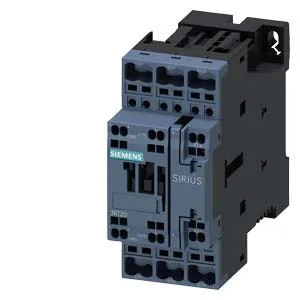
Its 200-280 V AC coil covers common European and North American control voltages, and the spring-type terminals on the coil side eliminate the need for screwdriver torque checks during commissioning. The main contacts are rated for switching at 24 V up to 10 A, at 48 V and 60 V up to 2 A, and at 110 V up to 1 A. That means this contactor handles low-voltage DC loads common in PLC output circuits or small solenoid valves, but the real work is AC motor duty: the AC-3 switching rate of 750 operations per hour tells you it's built for frequent starting of squirrel-cage motors, not just occasional on/off.
The S0 footprint is 45 mm wide, 102 mm tall, and 107 mm deep — it fits a standard 45 mm slot in a panel layout. Main contact terminals accept solid or stranded conductors from 1 to 10 mm², and fine-stranded wire with ferrules up to 2x 0.5-2.5 mm². The spring-type coil terminals are the same style — strip length around 8-10 mm, push to insert.
Operating conditions and switching performance
The coil picks up at 0.7 times rated voltage and drops out at 1.1 times rated — that's a standard hysteresis for AC contactors, ensuring reliable pull-in and clean drop-out without chatter. Coil holding power is 0.51 VA at 50 Hz and 0.56 VA at 60 Hz, so the control transformer load is minimal. Inrush current peaks at 25 A during coil energization — brief, but worth noting if the control supply is shared with sensitive electronics. The auxiliary switch is included.