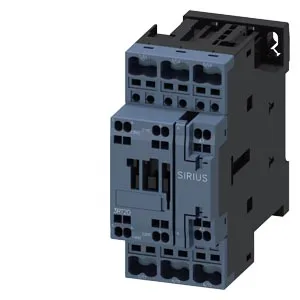
It mounts via screw or snap-on onto 35 mm DIN rail per DIN EN 60715, and the mounting position allows +/-180° rotation on a vertical surface plus +/-22.5° tilt forward and backward — useful when you're squeezing it into a tight panel corner.
Switching duty and frequency
Rated for 1 000 cycles per hour at AC-1 (resistive loads), 750 cycles/hour at AC-2 and AC-3 (slip-ring and squirrel-cage motors), and 250 cycles/hour at AC-4 (plugging/inching). The AC-3e rating also sits at 750 cycles/hour.
The main contact terminals accept solid or stranded wire from 1 to 10 mm²; auxiliary terminals accept 2x (0.5 to 2.5 mm²) solid or stranded. That 6 mm side clearance is tight — if you're packing multiple contactors side-by-side, leave that gap for heat dissipation.
Auxiliary switch is included. Rated currents: 10 A at 24 V, 2 A at 48 V and 60 V, 1 A at 110 V, 0.9 A at 125 V, 0.3 A at 220 V, 3 A at 400 V, 0.6 A at 440 V. These are the DC ratings for the auxiliary contacts — if you're switching a 24 VDC PLC input, you've got headroom; at 220 VDC the current drops to 0.3 A, so watch the load.