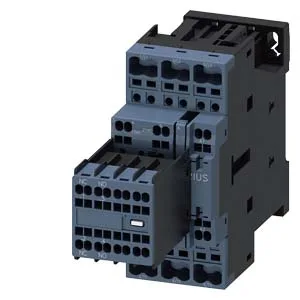
It mounts on 35 mm DIN rail per DIN EN 60715, using either screw fixing or the integrated snap-on latch, and the mounting position allows +/-180° rotation on a vertical surface plus +/-22.5° tilt forward and backward — useful when you're squeezing it into a crowded enclosure and need to orient the coil terminals toward the wiring duct. For heavier AC-4 duty (plugging, inching, reversing) the rate drops to 250 cycles per hour, reflecting the increased arc energy from breaking locked-rotor current. Coil connection uses spring-type terminals, so you're not torquing screws on the control wiring — strip, insert, done. The main power circuit accepts solid or stranded conductors from 1 to 10 mm², and the tightening torque range for the main contacts is 1.8 to 8 N·m, which covers standard power terminations up to that cross-section.
The 45 mm width is the critical panel-space figure for this Size S0 contactor — it occupies one standard 45 mm module on the DIN rail, so you can plan your rail fill around it. Depth is 144 mm, height 102 mm, which fits within typical 200 mm deep enclosures but check clearance for the arc chamber and coil terminals if you're mounting against a back panel. The rated operational current at 24 V is 6 A, at 400 V it's 3 A, and at 440 V it drops to 0.6 A — these are the switching current limits at those voltages, not the continuous thermal current. The contactor's thermal current rating (Ith) is not listed here, but the AC-1 maximum operating cycle rate of 1000 per hour suggests the resistive load handling is generous. The storage range is wider because the contactor isn't energized during storage, so the coil insulation and mechanical parts see a broader thermal cycle. No auxiliary switch block is included with this base variant — the 3RT2028-2AN24 ships as a bare contactor. If you need auxiliary contacts for status feedback or interlocking, you'll add a separate side-mounting block. The mechanical life is quoted at 10 million typical operations, which is the expected life before mechanical wear (spring fatigue, armature pivot wear) becomes an issue — electrical life will be shorter and depends on the switching current and duty cycle.
The lifecycle stage for the 3RT2028-2AN24 is recorded as current production — this is an active catalog item, not a phase-out or obsolete line. That means it's available through standard Siemens distribution channels and you can quote it against a BOM line without worrying about last-time-buy windows or forced redesigns. The SIRIUS platform is Siemens' mainstream industrial control range, so spares and replacements are broadly stocked. For a sourcing decision: this part is a standard catalog item, so the procurement posture is straightforward — specify it into the BOM, and it will be quoted to order through normal distribution. No special lead-time risk or allocation applies based on the lifecycle status alone.