What it is and what it does
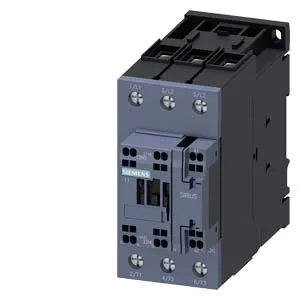
The Siemens 3RT2036-3AP60 is a SIRIUS power contactor in size S2, built for switching motor loads in industrial control panels. Its 52 A rating at 480 V AC-3 duty tells you it handles three-phase induction motors up to that current — the AC-3 category covers starting and disconnecting squirrel-cage motors under load, which is the real-world test for a contactor in a conveyor, pump, or fan circuit. The coil terminals use spring-type connections, so you land the control wiring without a screwdriver — a time-saver on the panel build. The main contact block is configured as 18 normally-open and 1 normally-closed, which is a common arrangement for a reversing or star-delta starter where you need the extra NO pole for a holding circuit or a status feedback to the PLC.
Mounting and integration
Mounts via screw or snap-on onto a 35 mm DIN rail per DIN EN 60715, so it drops into any standard panel enclosure. The mounting position is flexible: you can rotate it ±180° on a vertical surface, or tilt it forward/backward by ±22.5° — useful when you're routing cables around a crowded gland plate or aligning it with an existing busbar system. Clearance requirements are tight: 10 mm upwards and forwards, 6 mm at the sides, 10 mm downwards. That means you can pack contactors side-by-side without the usual 20 mm gap, which saves rail space in a multi-starter panel.
Ratings and what they mean for your application
The 52 A at 480 V AC-3 is the headline number — that's the motor-switching current. For resistive loads (AC-1), the contactor can handle higher currents, but the AC-3 figure is what governs motor duty. The mechanical service life is 10 million operations typical, so it's built for high-cycle applications like a bottling line or a packaging machine that cycles every few seconds. Switching frequency limits are given per duty class: 1000 cycles/hour for AC-1 (resistive), 800 for AC-3 (motor start/run), and 250 for AC-4 (plugging/inching). If your application requires frequent reversing or inching, the AC-4 limit of 250 cycles/hour is the binding constraint — don't exceed it or the arc chutes will wear prematurely. Operating temperature range is -25 to +60 °C, with storage from -55 to +80 °C. That covers most indoor panel environments, but if the contactor sits near a furnace or in a desert enclosure, the 60 °C upper limit is the hard stop — derating is required above that.
