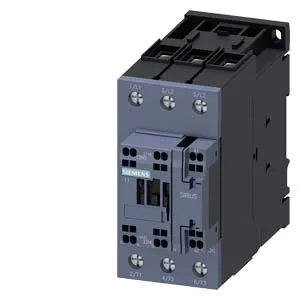
The Siemens 3RT2037-3AL20-ZW97 is a SIRIUS S2 power contactor — the core switching element for motor loads, resistive heaters, and transformer primaries in a 400–480 V panel. Spring-type terminals on the coil mean no screwdriver needed for the control wiring — a time-saver on the line when you're swapping a contactor under a headlamp. The main contacts use the same spring-cage style, accepting 2x 0.5–2.5 mm² solid or stranded.
The headline number is 65 A at 480 V under AC-3 duty — that's the motor-switching rating, the one that governs for a standard three-phase induction motor. That puts it in the S2 frame class, good for motors roughly up to 30–40 hp depending on your line voltage and duty cycle. Switching rates vary by duty: 800 cycles/hour for AC-1 resistive loads, 700/h for AC-3 and AC-3e motor starting, 400/h for AC-2 (slip-ring motors), and 200/h for AC-4 (plugging/inching). Pick the rate that matches your application — over-cycling on AC-4 will cook the contacts. Auxiliary contacts are built in: 1 N/O + 1 N/C as standard, which covers the basic feedback to the PLC or safety relay without adding a side-mount block. Coil pickup and dropout timing: 10–18 ms at AC, arcing time 10–20 ms. That's fast enough for most sequencing but worth knowing if you're coordinating with a soft-start or VFD bypass.
Environmental range and clearances
Clearance to adjacent devices: 10 mm upwards, 10 mm forwards, 10 mm downwards, 6 mm at the side — standard S2 spacing, no surprises.