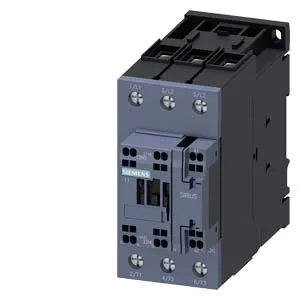
Its headline rating is 65 A at 480 V under AC-3 duty — that's the current it can reliably switch for a standard squirrel-cage motor during starting and running, which is the most common application for this class of contactor. The AC-3 rating is what governs fit for motor starting; a contactor's AC-1 resistive rating would be higher, but AC-3 is the number that matters for inductive motor loads.
Switching frequency and endurance
Rated for up to 700 switching cycles per hour under AC-3 duty, and 800 under AC-1 resistive load. That's typical for a general-purpose contactor — enough for conveyor cycling or pump starts, but not for high-speed indexing applications where you'd need a dedicated DC-operated or higher-frequency device.
Coil and auxiliary contacts
The magnet coil connection uses spring-type terminals, which speeds up wiring compared to screw terminals — no torque driver needed, just strip and insert. The contactor carries an auxiliary switch block (1 N/O + 1 N/C configuration from the main contact count of 18...1), so it can report its status back to a PLC or safety relay without an add-on module.
Clearances and thermal environment
Dimensions are 114 mm high, 55 mm wide, and 130 mm deep — the S2 footprint is compact enough for high-density panel layouts.