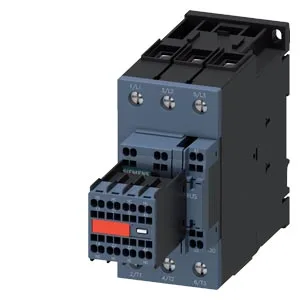
The 3RT2037-3NB34-3MA0: The coil is rated 20...33 VDC and draws a 6 A inrush at 24 V, holding at 2 VA on 50/60 Hz. That's a standard 24 VDC control voltage range — common across most PLC-driven panels. The spring-type terminals on the coil side save wire-prep time compared to screw clamps.
The 55 mm width and 114 mm height mean it takes up a standard three-module footprint on the rail — plan for that when laying out your enclosure. Depth is 178 mm, which is typical for this frame class; watch your gland-plate clearance if the panel is shallow.
Switching performance and contact configuration
Main contacts are 3-pole normally open (18...1 configuration — three NO poles). No auxiliary switch is built in, so if you need feedback for a PLC input, plan on adding a separate auxiliary contact block alongside it. Rated switching rates: 800 ops/h for AC-1 resistive loads, 700 ops/h for AC-3 motor starting, and 200 ops/h for AC-4 plugging/reversing. Mechanical life is 10 million cycles typical, so this contactor will outlast most machine rebuild cycles. Arcing time runs 10...20 ms, and total operating time (both AC and DC) is 30...55 ms — fast enough for standard motor control but not for high-speed synchronous transfer applications.
Environmental limits and wiring
Wire size for main contacts accepts 2x 0.5...2.5 mm² solid or stranded. Keep strip length standard for spring terminals — about 10 mm — and you'll get a solid pull-out force.