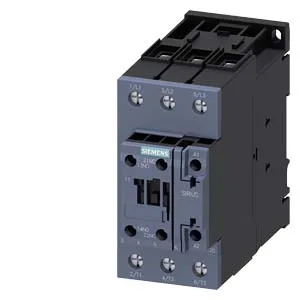
The S2 frame size tells you it handles the mid-range of the SIRIUS contactor family — above the S0, below the S3 — and the 65 A rating at 480 V AC-3 means it's sized for a 30–40 hp motor on a 480 V line, typical for pumps, fans, or conveyors in a 480 V plant. The -ZX95 suffix is a Siemens special version code — it doesn't change the electrical ratings, but it flags a specific variant (often a customer-specific or custom-logged build). The base contactor carries an auxiliary switch as standard, with coil terminals as screw-type. Wire acceptance is 2x 0.5–1.5 mm² or 2x 0.75–2.5 mm² solid/stranded, which covers most panel wiring up to 12 AWG.
The headline number is 65 A at 480 V — that's the AC-3 (motor starting) rating. AC-3 means switching a squirrel-cage motor: high inrush on make, lower current on break. For resistive loads (AC-1), the contactor can cycle more often — 800 ops/hour — but the AC-3 duty cycle of 700 ops/hour is the one that governs motor switching. The AC-4 rating (plugging/reversing) drops to 200 ops/hour, so if your application does frequent inching or reversing, derate the switching rate accordingly. The auxiliary contacts are rated across a range of voltages: 10 A at 24 V, 2 A at 48 V and 60 V, 1 A at 110 V, 0.9 A at 125 V, 0.3 A at 220 V, 3 A at 400 V, 0.6 A at 440 V, and 2 A at 500 V. That covers standard control voltages in both 24 VDC and 120/240 VAC control circuits. The 10 hp rating at 230 V gives a quick rule-of-thumb for 230 V single-phase motor loads. Arcing time is 10–20 ms, and operate time at AC is 10–18 ms. These are fast enough for most motor control circuits; the contactor closes and opens cleanly within a half-cycle of 50/60 Hz.
Physical footprint: 114 mm high, 55 mm wide, 130 mm deep. That's the body dimensions; you need clearance for arc chutes and wiring. On a 35 mm DIN rail, the S2 width of 55 mm means it occupies about 3.1 standard 18 mm module spaces — plan your rail layout accordingly. That covers most panel orientations, including horizontal rails in a vertical enclosure. The storage range is wider — that's the handling/shipping limit, not the running limit.