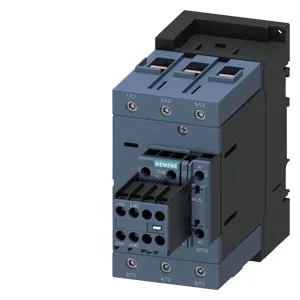
That 195 mm depth plus the 20 mm forward clearance means you need about 215 mm of clear depth in the enclosure from the DIN rail face to the door or back panel.
Main contact terminals accept solid wire from 2.5 to 16 mm², or stranded from 6 to 70 mm². The auxiliary contact block accepts 2x (0.5 to 1.5 mm²) or 2x (0.75 to 2.5 mm²) solid or stranded. Coil connections are screw-type terminals. That stranded range up to 70 mm² is generous — it lets you parallel feed conductors for higher current without needing a separate terminal block.
Environmental and duty ratings
Switching frequency varies by duty: AC-1 (resistive) max 900 cycles/hour, AC-2 max 400, AC-3 and AC-3e max 1000, AC-4 max 300. The AC-3e rating at 1000 cycles/hour matches the standard AC-3 figure, so it handles motor starting duty at that rate without derating.
The built-in auxiliary switch is rated for inductive loads at various control voltages: 6 A at 24 V, 2 A at 48 V and 60 V, 1 A at 110 V, 0.9 A at 125 V, 0.3 A at 220 V, 3 A at 400 V, and 0.8 A at 440 V. At 230 V it's rated 15 hp. These are the inductive (AC-15 / DC-13 style) ratings — the actual make/break capability for pilot duty. If you're switching a PLC output or relay coil at 24 VDC, the 6 A rating gives plenty of headroom for inrush.