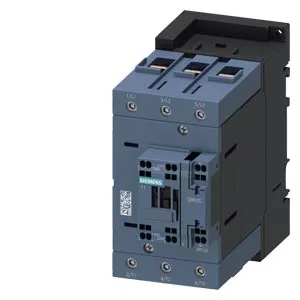
SIRIUS S3 Power Contactor — 83–155 V Coil, Spring-Terminal
It mounts on 35 mm DIN rail per DIN EN 60715 via screw or snap-on fastening, with a mounting position that allows ±180° rotation on a vertical surface and ±22.5° tilt forward or backward — useful when fitting into tight enclosures or existing layouts. The coil accepts 83–155 V AC/DC with an inrush peak of 1.5 A and a holding draw of 3.5 VA at both 50 Hz and 60 Hz. That coil voltage range covers common 110–120 V control circuits in North America and 110 V nominal in European schemes, so it slots into standard control transformers without a separate dropping resistor. Main contact wire range accepts solid conductors from 2.5 to 16 mm² and stranded from 6 to 70 mm² — heavy enough for the S3 frame's typical motor currents. Auxiliary contacts are present and rated at 10 A at 24 V, 2 A at 48 V and 60 V, and 1 A at 110 V, which covers pilot-duty and PLC input signalling without an interposing relay.
Duty-Cycle Rates — Which One Governs Your Load
The 3RT2047-3NF30 is rated for different switching frequencies depending on the duty category. For AC-1 (resistive loads) it manages 900 operations per hour; for AC-3 (squirrel-cage motor starting) it handles 850 per hour; AC-2 (slip-ring motor starting) drops to 350 per hour; and AC-4 (plugging/inching) is limited to 200 per hour. The AC-3e rating mirrors the AC-3 figure at 850 per hour. If your application involves frequent jogging or reversing, the AC-4 ceiling is the one that governs contact life — plan around 200 cycles/hour max, not the higher AC-3 number.
Dimensions are 140 mm high, 70 mm wide, and 152 mm deep. The spring-type terminals on the coil accept solid or stranded wire 2x (0.5–2.5 mm²). The contactor carries auxiliary switches as standard, so no separate add-on block is needed for basic signalling.