What it is and what it does
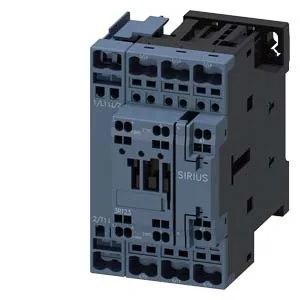
The Siemens 3RT2325-2AG20-1AA0 is a SIRIUS contactor in the Size S0 frame, built for switching motor loads and resistive circuits in industrial control panels. The coil pulls in on 110 V AC at 50 Hz or 60 Hz, with a spring-type terminal block on the coil side that accepts 2x (0.5... 2.5 mm²) solid or stranded wire — no ring lugs needed, which saves time on the wireman's bench. Size S0 is the mid-range footprint in the SIRIUS family: 60 mm wide, 102 mm tall, 97 mm deep. That 97 mm depth is the dimension that matters when you're reaching into a shallow backpanel enclosure — it's the distance from the DIN rail face to the farthest projection of the contactor body.
Mounting and panel fit
Fastens by screw or snaps onto standard 35 mm DIN rail per DIN EN 60715. Mounting position is standing on a horizontal surface. Clearance specs: 10 mm upwards, 10 mm forwards, 10 mm downwards, and 6 mm at the side — these are the minimum air gaps to adjacent components or the enclosure wall for heat dissipation and arc containment. The main contact terminals accept 1... 10 mm² stranded wire; the auxiliary and coil terminals take 2x (0.5... 2.5 mm²) solid or stranded. That's enough for most motor branch circuits up through the contactor's rating, but if you're paralleling feeds you'll want to land a single larger conductor rather than double up.
Ratings and what they mean for the line
The auxiliary contact block carries a full set of switched-current ratings across common control voltages. At 24 V AC it's rated 10 A; at 230 V AC it's still 10 A; at 400 V AC it drops to 3 A. That tells you the contact set is designed for general-purpose pilot duty, not for switching heavy motor loads directly — it's the signal side, not the power side. Operating temperature range is -25 to +60 °C, storage from -55 to +80 °C. Out here in the grease, that means it'll sit in a hot panel next to a VFD or near a steam line without derating — the -25 °C floor covers cold starts in unheated pump houses. The mechanical life is listed at 10 million operations typical, which is standard for a contactor this size; you'll wear out the coil or the load contacts long before the mechanism gives up.
