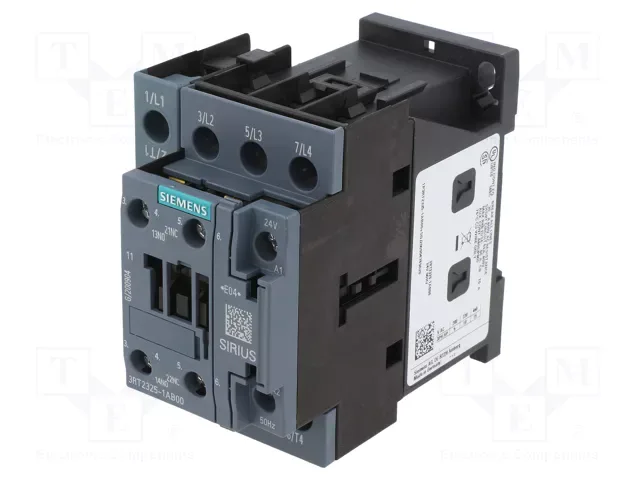
The main contact set is rated for AC operation with a switching time of 4 to 16 ms and an arcing time of 10 ms, so it handles the break-and-make cycle cleanly on inductive loads.
Mounting and panel fit — the DIN-rail reality
The footprint is 60 mm wide, 102 mm tall, 97 mm deep — that depth matters when you're laying out a gland plate or door clearance. That side clearance is tight — you can stack them close, but leave the vertical gaps for wiring access.
Wiring — spring terminals on the coil, screw on the mains
The coil connection uses spring-type terminals (push-in style), accepting 2x solid 0.5 to 2.5 mm² or 2x stranded 0.5 to 2.5 mm². That's a solid range for panel wiring — the coil side gets the smaller control wiring, the mains side takes the power conductors up to 10 mm². An auxiliary switch block is attachable (2 units possible), so you can add feedback or status contacts without extra DIN rail space.
The contactor's rated operational current at 24 V is 10 A, at 48 V is 2 A, at 60 V is 6 A, at 110 V is 1 A, at 125 V is 0.9 A, at 220 V is 0.3 A, at 230 V is 10 A, at 400 V is 3 A, at 500 V is 2 A, and at 600 V is 0.1 A. Those are the current-carrying capacities at those specific voltage levels — they define the load you can switch, not just the coil. The 230 V 10 A rating is the headline figure for a standard motor circuit at that voltage.