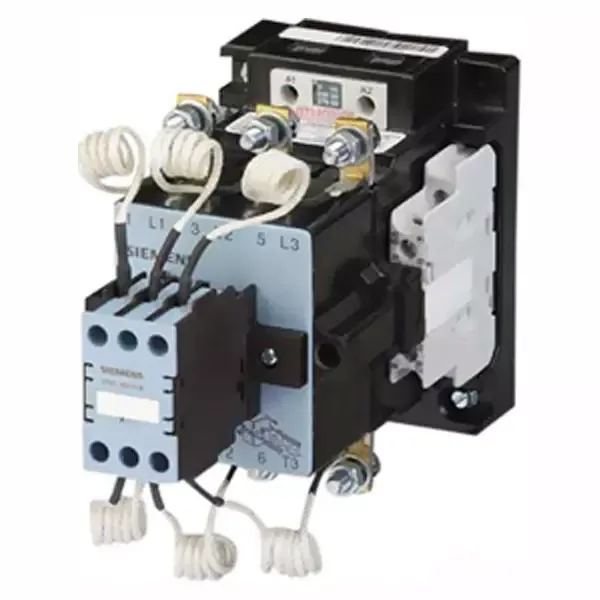
The 3RT2637-1AB05 is a SIRIUS capacitor contactor from Siemens, size S2, built for switching capacitor banks in power-factor correction panels. Its job is to handle the inrush currents that pop up when you slam a capacitor bank onto the line — a regular contactor will weld its contacts doing that job. The coil termination uses screw-type terminals, so you're not fighting cage clamps out here in the grease.
That's handy when you're squeezing it into a crowded panel next to the capacitor bank. Dimensions are 65 mm wide, 114 mm tall, 130 mm deep — standard S2 footprint, so it'll drop into any panel laid out for that size.
The real work is the inrush, which this contactor handles without welding. Switching frequency tops out at 100 operations per hour at 230 V, 400 V, and 240 V; drop to 50/h at 480 V, 45/h at 500 V, 32/h at 600 V, and 25/h at 690 V. That's the thermal limit of the arc chute — respect those numbers if you're cycling capacitors hard.
Wiring and conductor sizing
The main power terminals accept solid conductors: 2x (0.5 to 1.5 mm²), 2x (0.75 to 2.5 mm²), or 2x 4 mm². For stranded, they take 2x (10 to 35 mm²) or 1x (10 to 50 mm²). At 40 °C ambient, you can land a single 50 mm²; at 60 °C, two 35 mm². That's enough copper for the capacitor bank feed. The auxiliary contacts — one instantaneous contact — are rated 6 A at 24 V, 2 A at 60 V, 1 A at 110 V, 0.9 A at 125 V, 0.3 A at 220 V, 3 A at 400 V, and 0 A at 690 V. Use those for the control circuit feedback, not the main power.