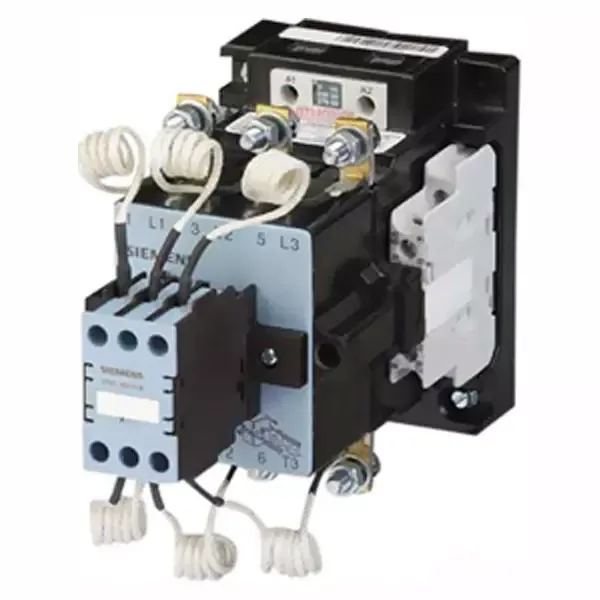
The 230 V AC coil at 50 Hz is the standard pickup voltage for European industrial panels; the 0.8... 1.0 × Us operating range means the coil holds in at 184 V and drops out below about 184 V, which keeps it from chattering on a sagging line feeding a capacitor bank. Capacitor contactors include pre-charge resistors that limit inrush when switching a discharged capacitor bank. The 3RT2637-1AP05 is rated for a maximum switching frequency that depends on the line voltage.
Mounting and integration — DIN-rail fit
That gives the panel builder room to orient the contactor for gland-plate clearance or cable routing — useful when shoehorning it into a crowded S2 slot. Dimensions are 65 mm wide, 114 mm high, 130 mm deep. The depth is the critical fit dimension when the contactor sits behind a door or near a backplane. The S2 frame is a common Siemens footprint; if you are replacing an older S2 contactor, the 3RT2637-1AP05 should drop into the same DIN-rail position without re-drilling the plate.
The main power terminals accept solid conductors: 2 × (0.5... 1.5 mm²), 2 × (0.75... 2.5 mm²), or 2 × 4 mm². For stranded conductors the range is 2 × (10... 35 mm²) or 1 × (10... 50 mm²). The coil terminals are screw-type, which is standard for this class — no push-in or spring-cage on the coil circuit, so plan for a screwdriver at termination. At 40 °C ambient the contactor can terminate a single 50 mm² conductor; at 60 °C it derates to 2 × 35 mm². That thermal derating is the practical limit for a high-ambient panel near a capacitor bank — if the enclosure runs hot, step down the wire size accordingly.
Environmental and handling
The storage range exceeds the operating range.