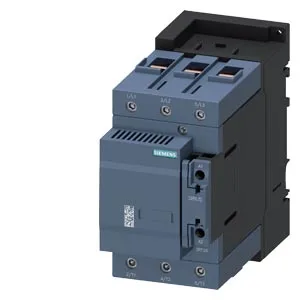
The Siemens 3RT2645-1NF35 is a SIRIUS contactor with an AC/DC coil rated 83–155 V at 50/60 Hz. The 80 mm width and 152 mm depth mean it takes up a standard three-module footprint — no surprises when you're laying out a row of contactors and overloads.
This contactor switches 6 A at 24 V and 230 V, and 3 A at 400 V. At 690 V it is rated 0 A — it is not built for that voltage class. The operating times are 38–57 ms for both AC and DC, and the arcing time runs 10–20 ms. That is typical for a contactor this size; the arcing time tells you how long the contacts carry current after opening, which matters for contact life on inductive loads like small motors or solenoids. Maximum operating frequency depends on the voltage you are switching: 200 operations per hour at 230–240 V, dropping to 30 per hour at 600–690 V. If you are cycling a load at high voltage, this contactor is not meant for rapid switching — it is a general-purpose machine for moderate duty cycles.
Wire terminations — what fits and what does not
The main power terminals accept solid wire in combinations: 2x (0.5–1.5 mm²), 2x (0.75–2.5 mm²), or 2x 4 mm². For stranded wire, it takes 2x (10–70 mm²) or 1x (10–70 mm²). The coil uses screw-type terminals. That covers most panel wiring from control circuits up to moderate power feeds. If you are landing 70 mm² stranded, make sure your lug or ferrule fits the terminal opening — the spec says it accepts it, but the physical space is tight.
Environmental limits and mounting flexibility
That is a wide thermal margin — it handles a hot panel in a steel mill or a cold warehouse. That helps when you are shoehorning it into a tight enclosure and the DIN rail is not perfectly square.