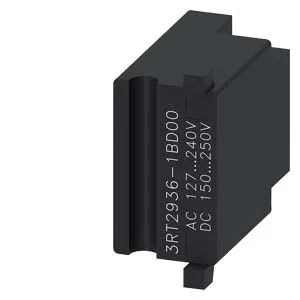
What it is — and why the varistor matters
The 3RT2936-1BD00 is a SIRIUS surge suppressor for Siemens contactors — specifically a varistor type, meaning it clamps voltage spikes across the coil terminals rather than using an RC snubber or diode. That matters in a panel: a varistor handles both AC and DC coils (: AC/DC) and doesn't introduce a half-wave rectification issue that can hold a DC contactor in on loss of phase. Rated for 127-240 V AC at 50/60 Hz, and 150-250 V DC. The overlap between the AC and DC ranges means one part number covers both a 230 V AC coil and a 220 V DC coil in the same cabinet — fewer line items on the BOM.
Fits 3RT2.3 and 3RT2.4 — clip-on, any orientation
This suppressor mounts directly onto the contactor via clip-on fastening. No screws, no DIN-rail space consumed — it snaps onto the coil terminals of size S2 or S3 contactors (: 3RT2.3 and 3RT2.4). The mounting position is any orientation, so you can install it on a contactor mounted sideways or upside-down in a tight cabinet without derating. Dimensions are compact: 30 mm wide, 30 mm tall, 15 mm deep. That 15 mm depth is the projection off the contactor face — check clearance to the enclosure door or adjacent components if you're packing the panel tight.
Active lifecycle — no obsolescence worry
Siemens lists this as an active product. No NRND flag, no last-time-buy notice. For a BOM freeze or a panel-builder buying multiple cabinets, the supply chain risk here is low — it's a current catalog item, not a legacy part you're chasing through surplus. RoHS compliance is confirmed with a substance prohibition date of 10/01/2014, which covers the EU RoHS directive.
Temperature tolerance — panel environment matters
Operating range is -25 to +60 °C, storage range -40 to +80 °C. The -25 °C low end means it's fine for unheated warehouses in most climates, but if you're in a northern plant with ambient below that at startup, the varistor's clamping voltage shifts with temperature — it still functions but the protection threshold rises. Storage at -40 °C is fine; let the assembly warm before energizing to avoid thermal shock on the ceramic disc inside the varistor.