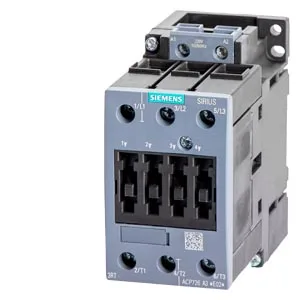
Switching frequency: 5 000 operating cycles per hour at AC, with 1 200 cycles/h for AC-1 (resistive) and 1 000 cycles/h for AC-3 (motor) duty. The AC-4 maximum is 250 cycles/h — that's the heavy inching or plugging duty, so if your application does frequent reversing or jogging, stay under that ceiling. Coil pickup at 24 V is 6 A; at 110 V it drops to 1 A, and at 230 V it's 6 A again — note the higher inrush at 230 V. Motor power ratings at 60 °C: 18 kW at 230 V, 31 kW at 400 V, 54 kW at 690 V. These are the thermal continuous ratings — size your motor load against these, not the 40 °C figures, if your panel ambient runs warm.
Main circuit terminals are screw-type, accepting 2x 0.75–16 mm² solid or stranded, or 2x 18–2 AWG. At 60 °C the minimum wire size is 10 mm². The 55 mm width and 115 mm depth fit standard enclosure depths. An auxiliary switch can be added via the product extension slot, so you can add status feedback without external relays.