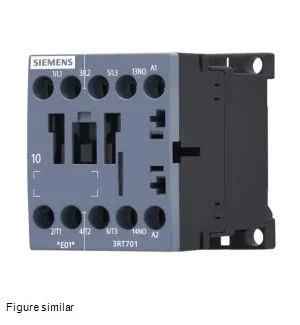
It carries three normally open main contacts rated for AC-3 duty up to 690 V, with a rated operational current of 6 A at 230 V and 3 A at 400 V. This puts it squarely in the small-motor and light-load range — think fractional-horsepower pumps, small fans, or conveyor drives where the full-load amps stay under 6 A.
The AC-3 rating is the one that matters for motor starting: 6 A at 230 V and 3 A at 400 V. AC-3 covers starting and disconnecting squirrel-cage motors under load, so that 6 A figure is the maximum continuous motor current the contactor can handle through start and run. For resistive loads (AC-1), you get a higher current, but the AC-3 number is the binding one for induction motors. The contactor also carries a 1 A rating at 690 V, which covers applications on higher-voltage systems like 690 V three-phase grids common in heavy industrial or mining. Switching frequency is capped at 750 operations per hour under AC-3 duty and 250 per hour under AC-4 (plugging or inching). That 750 ops/h is fine for a pump cycling on a level switch or a conveyor start-stop, but if you're doing rapid reversing or jogging, the AC-4 limit of 250 ops/h governs — exceed it and the arc erosion accelerates. The coil draws 0.27 W holding power at DC and a brief 0.8 W closing pulse, which is low enough to drive directly from a PLC output or a small control transformer without worrying about coil dropout. That 6 kV figure means it can handle the voltage spikes common in industrial panels with long motor cables or nearby VFDs — you don't need a separate surge suppressor for this contactor in most installations.
Mounting and integration details
Terminals are screw-type for both main and control circuits. Wire sizes accepted: 2x 0.5 to 1.5 mm² solid or stranded, or 2x 0.75 to 2.5 mm². That covers standard panel wiring up to about 14 AWG. For the main circuit, the recommended fuse is a gL/gG NH 3NA: 20 A for type 2 coordination (no damage to the contactor under short circuit) or 35 A for type 1 coordination (contactor may need replacement after a fault). The contactor accepts auxiliary switch blocks on the front, so you can add a feedback contact for the PLC or a status indicator.