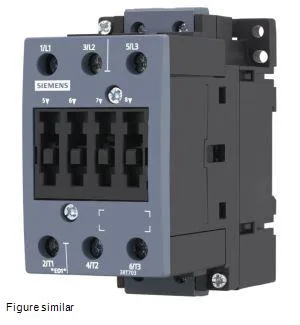
Rated insulation voltage is 690 V, and the maximum operating voltage in AC-3 duty is also 690 V — so this contactor handles 400 V and 480 V motor circuits without derating, and can switch 690 V loads within the AC-3 switching frequency of 800 operations per hour. The AC-3 maximum switching rate of 800 1/h means it is sized for moderate-duty motor starting; the AC-4 rate drops to 250 1/h, which governs inching or plugging applications where the contactor makes and breaks full motor current under stalled-rotor conditions. For DC-13 loads at 220 V, the rated operational current is 0.3 A — enough for a DC brake coil or small solenoid, not a main motor. The coil holds at 24 V AC nominal, drawing 0.42 A at both 50 Hz and 60 Hz. Closing power is 0.78 W DC equivalent; holding power drops to 0.42 W DC. That low holding draw means the control transformer can be sized lean — a 50 VA transformer will comfortably power several of these in a panel. Operating temperature range is -10 to +55 °C, storage from -25 to +70 °C. The shock resistance figures — 15g for 5 ms and 8g for 10 ms — are solid for a contactor mounted on a DIN rail in a panel near vibrating machinery, but not rated for direct mounting on a crusher or vibrating screen without additional damping.
For type of coordination 2 (short-circuit protection allowing contactor damage), the required gL/gG fuse is 80 A NH 3NA. These fuse sizes tell you the upstream protection needed for a 3-pole motor circuit; the contactor itself is not the short-circuit protective device.
The contactor is a standard catalog item, not a special or configured variant, so lead times are typical for the SIRIUS 3RT7 series.