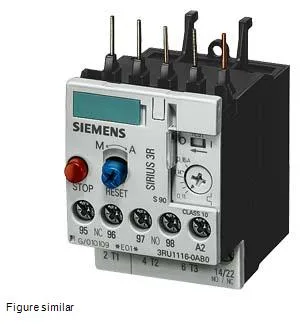
This relay fastens directly to a contactor (contactor mounting per), so it adds no DIN-rail width to the assembly — the 45 mm width and 87 mm height match the S00 contactor footprint. Depth is 78 mm from the mounting surface. The mounting position allows a vertical surface with ±135° rotation or ±45° tilt front-to-back, giving flexibility in tight enclosures.
Both main and auxiliary/control circuits use screw-type terminals. The main circuit accepts solid or finely stranded conductors: 2× (0.5…1.5 mm²) and 2× (0.75…2.5 mm²), or AWG equivalents 2× (20…16), 2× (18…14), and 2× 12. Auxiliary contacts use 2× (20…16) and 2× (18…14) AWG. Three poles for the main current circuit.
Auxiliary contact ratings and thermal dissipation
The auxiliary contact block carries 1 A at 24 V, 3 A at 120 V, 2 A at 230 V, and 1 A at 400 V. For DC control circuits: 0.22 A at 110 V, 0.22 A at 125 V, and 0.11 A at 220 V. Each pole dissipates 1.6 W — factor that into enclosure heat calculations if the relay is grouped with other heat sources.
It operates in 100% relative humidity. Shock resistance is 8g for 10 ms, and surge voltage withstand is 6 kV. ATEX certification (DMT 98 ATEX G 001) qualifies it for potentially explosive gas atmospheres. RoHS substance prohibition date is July 1, 2006. The lifecycle stage is current production.