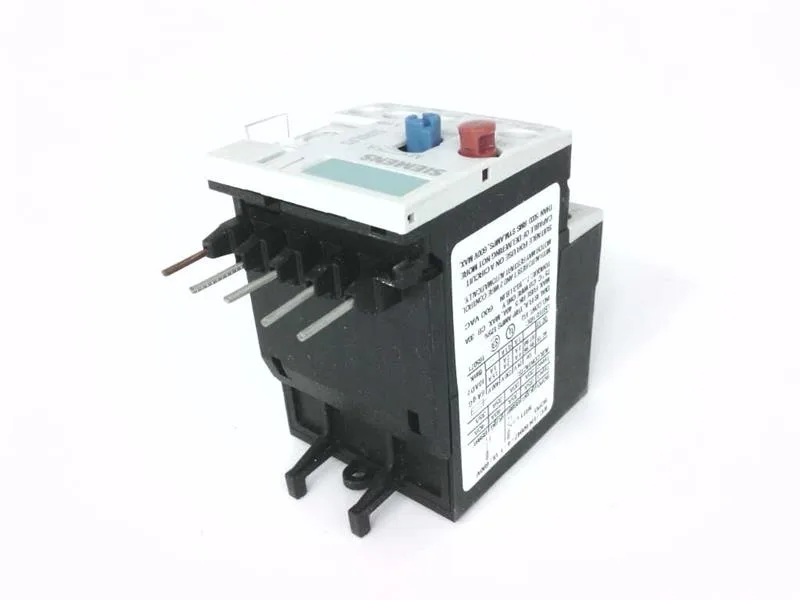
The Siemens 3RU1116-1JB0-ZW95 is a SIRIUS thermal overload relay in the S00 frame size, designed to protect three-phase motor circuits against overload and phase failure.
Mounting and wiring realities
The 3RU1116-1JB0-ZW95 accepts solid and finely stranded conductors with core-end processing: 2× (0.5 … 1.5 mm²) and 2× (0.75 … 2.5 mm²) per terminal, or the AWG equivalents 2× (20 … 16) and 2× (18 … 14). Both main and auxiliary/control circuits use screw-type terminals — no spring-cage adapters needed, but you'll want a Pozidriv bit on the torque driver. Mounting position is flexible: vertical surface with ±135° rotation or ±45° tilt front/back. That zero-clearance top and bottom means you can stack relays tight in a multi-row panel without derating for airflow — handy when you're filling a crowded enclosure.
Operating temperature range is -20 … +70 °C, storage and transport -55 … +80 °C. The relay carries IP20 finger-safe touch protection on the front and is approved for ATEX Zone 2 / Zone 22 (DMT 98 ATEX G 001). Surge voltage resistance is rated at 6 kV. Shock resistance is 8g / 10 ms. Relative humidity during operation can hit 100 % — no derating needed for condensing environments.
Auxiliary contact ratings
Auxiliary contact ratings cover common control voltages: 1 A at 24 V, 3 A at 120 V, 2 A at 230 V, 1 A at 400 V. For DC applications: 0.22 A at 110 V, 0.22 A at 125 V, 0.11 A at 220 V. Power dissipation per pole is 2.2 W — factor that into your enclosure thermal budget if you're running near the upper ambient limit.