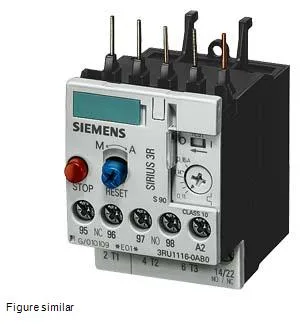
It mounts directly onto a SIRIUS contactor — no separate bracket needed — and trips according to CLASS 10 characteristics, meaning it will open the circuit within 10 seconds at a 7.2× current overload. That timing is standard for standard-start induction motors; if you're protecting a motor with a long start-up time (heavy inertia loads like a centrifuge or large fan), you'd want a higher class like CLASS 20 or 30, but for most pump, conveyor, and compressor duty, CLASS 10 is the right call. It carries an ATEX approval (DMT 98 ATEX G 001), so it's suitable for use in potentially explosive atmospheres — think grain elevators, chemical plants, or paint booths where a motor overload could ignite the environment. The front face is IP20, which is standard for inside a panel; you won't get a finger in there, but it's not sealed against dust or water ingress, so keep it behind the enclosure door.
Mounting and wiring — what fits where
It measures 45 mm wide, 87 mm tall, and 78 mm deep — that's a compact footprint that fits a standard 45 mm-wide contactor footprint. The main circuit accepts 2x (0.5 to 1.5 mm²) solid or 2x (0.75 to 2.5 mm²) finely stranded with ferrule — that covers most motor leads up to about 2.5 mm² (roughly 14 AWG). Auxiliary contacts take similar sizes: 2x (0.5 to 1.5 mm²) solid or 2x (0.75 to 2.5 mm²) stranded. If you're wiring with AWG, the main terminals accept 2x (20 to 16) or 2x (18 to 14) or 2x 12, and auxiliary take 2x (20 to 16) or 2x (18 to 14). So you can land a 12 AWG motor lead on the main circuit, but the auxiliary side tops out at 14 AWG — watch that when you're looping through the aux contacts for a control signal.
Electrical ratings and power dissipation
The auxiliary contacts are rated for a range of control voltages: 1 A at 24 V, 3 A at 120 V, 2 A at 230 V, and 1 A at 400 V. That means the contacts can handle the typical PLC input or contactor coil draw at common control voltages — just don't try to switch a motor load through them; they're for signaling, not power. Each pole dissipates 1.9 W, so three poles add up to about 5.7 W of heat inside the enclosure. In a densely packed panel, that's worth considering for thermal management — especially if you're stacking several relays side by side with zero clearance. Shock resistance is 8g for 10 ms — that's enough for most industrial environments unless you're mounting it directly on a vibrating machine frame.