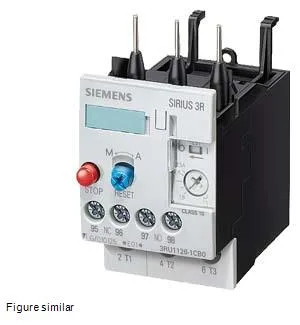
The relay mounts stand-alone on a vertical surface, rotatable ±135° and tiltable ±45°, which gives panel builders flexibility in tight enclosures.
The CLASS 10 trip class is the headline rating here. For a motor driving a pump or conveyor, that's enough headroom to ride through an across-the-line start while still protecting the winding if the rotor locks. The S0 frame size tells you the physical envelope: 45 mm wide, 97 mm tall, 96 mm deep — a standard footprint that fits alongside S0 contactors in a motor starter lineup. Auxiliary contact ratings are given at multiple control voltages: 1 A at 24 V, 3 A at 120 V, 2 A at 230 V, and 1 A at 400 V. These are the make/break capacities for the N/O and N/C contacts that signal the trip condition to a PLC or safety circuit. The 0.22 A rating at 110 V and 125 V covers common control transformer secondaries. Power dissipation is 8.1 W total (2.7 W per pole) in the hot operating state — factor that into your enclosure thermal budget. The relay accepts solid conductors 2x (0.5 to 2.5 mm²) and finely stranded with ferrule 2x (0.5 to 1.5 mm²) on the main circuit screw terminals. AWG equivalents are 1x (16 to 12) or 1x (14 to 8). Shock resistance is 8g for 10 ms — robust enough for most industrial machinery.
The relay carries ATEX protection type DMT 98 ATEX G 001, certifying it for use in potentially explosive atmospheres (Gas Group II, Category 2G).
Mounting position allows vertical surface installation with ±135° rotation and ±45° tilt forward/back — useful when the relay must angle away from a busbar or gland plate. That zero-clearance top and bottom means you can stack S0 devices without wasting DIN rail space, but the 6 mm side gap must be maintained for cooling and wiring access. Operating altitude is rated to 2 000 m without derating. Relative humidity tolerance is 100 % during operation — condensation is acceptable, but the IP20 front means the relay itself isn't sealed against liquid ingress; it relies on the enclosure for that.