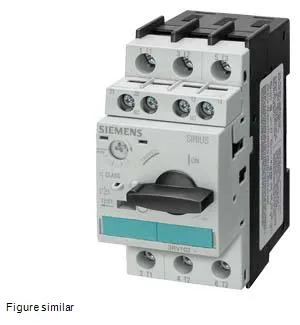
What this SIRIUS breaker does on the line
Its continuous rated current is 0.25 A, and it trips in CLASS 10 — meaning it will open within 10 seconds at 7.2× the set current, fast enough to protect a standard induction motor rotor from thermal damage during a stall or locked-rotor condition. That 0.25 A rating makes this the fine-end of the SIRIUS range, sized for fractional-horsepower motors, small pumps, or control transformers. It accepts solid conductors 2x (0.5...1.5 mm²) and 2x (0.75...2.5 mm²), and stranded 2x (1...2.5 mm²) and 2x (2.5...6 mm²). Mounting position is any, with 0 mm spacing required backwards and at the sides.
Breaking capacity and fault clearance
Rated breaking capacity is 100 kA at 240 V, 400 V, 500 V, and 690 V AC (–). That's a consistent 100 kA across the voltage range — unusual and valuable, because it means the breaker clears a bolted fault at 690 V just as decisively as at 240 V, without derating its interrupting capability. For a motor branch circuit, this SCCR headroom simplifies panel coordination: downstream contactors and overloads don't need separate current-limiting fuses in most installations.
Environmental and mechanical ruggedness
Shock resistance rated at 25g for 11 ms — that's a solid spec for a breaker mounted on a machine frame or near a reciprocating compressor.
Protection functions and auxiliary wiring
Ground fault detection is not included. An auxiliary switch is present, with 0 factory-fitted auxiliary contacts for the main current circuit — the transverse auxiliary switch design means you add auxiliary blocks on the side as needed. Switching frequency at AC-3 duty is rated at a maximum 15 operations per hour. Mechanical endurance of the main contacts is 100,000 operations typical.
Width is 45 mm, height is 97 mm, depth is 96 mm. The 96 mm depth includes the terminal body and any protruding screw heads; panel depth should allow at least 110 mm clearance behind the door for wiring access.