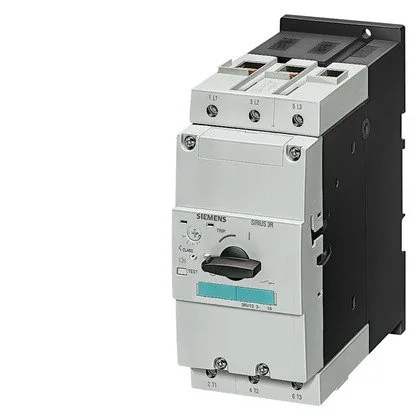
It's designed for motor protection in main current circuits, with three poles and screw-type box terminals for the power side and separate screw terminals for the auxiliary/control circuit. It includes phase failure detection, so it will trip if one phase drops out — a common failure mode that cooks motors if undetected.
Breaking capacity and voltage class
This breaker carries a 690 V rated insulation voltage and an AC-3 rated voltage maximum of 690 V. The breaking capacity is rated per voltage: 100 kA at 240 V AC, 50 kA at 400 V AC, 12 kA at 500 V AC, and 6 kA at 690 V AC. At 400 V, it's rated for 30 kW motor load.
Any mounting position is allowed. Dimensions are 70 mm wide, 165 mm high, 174 mm deep — no extra clearance needed at the sides or back. Front-side IP20 protection, so it's fine for a standard IP2X enclosure. The wire terminals accept solid conductors 2x (2.5…16 mm²) and stranded 2x (10…50 mm²) or 1x (10…70 mm²), plus fine-stranded with ferrule 2x (2.5…35 mm²). AWG equivalents are 2x (10…1) for the main contacts. That's a wide wire range — covers most motor feeders from fractional-hp up to about 30 kW at 400 V.
Power loss and operating frequency
Total power loss in hot operating state is 34 W, or 11.3 W per pole. Maximum operating frequency at AC-3 duty is 15 operations per hour — that's fine for a motor start application like a pump or conveyor, not for a high-cycle stamping press.