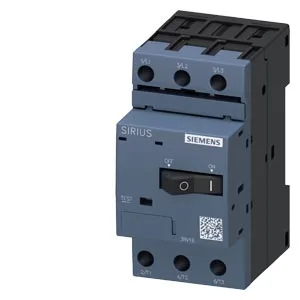
What this SIRIUS breaker does in a panel
The Siemens 3RV1641-4MK10-0AA4 is a SIRIUS circuit breaker designed for distance relay applications — meaning it protects motor feeders in a control panel where the breaker sits remotely from the contactor, typically in a separate enclosure or further down the DIN rail. It carries a continuous current rating of 63 A and switches motor loads up to 30 kW at 400 V in AC-3 duty, which covers most standard induction motors on a 400 V three-phase line. The 70 mm wide body snaps onto a 35 mm DIN rail per EN 50022, and the screw-type box terminals accept solid conductors up to 16 mm² or stranded up to 70 mm² — enough for the feed side of a 30 kW motor circuit.
This breaker's interrupting rating changes with line voltage, which is typical for a compact MCCB-class device. At 240 V AC it clears 100 kA; at 400 V AC it handles 50 kA; at 500 V AC it drops to 12 kA; and at the rated insulation voltage of 690 V AC it still interrupts 6 kA.
Survives the nacelle — temperature and shock ratings
Shock resistance is rated at 25 g for 11 ms, which is the kind of transient you get from a blade-pitch stop or a grid-side breaker slamming shut. The IP20 front protection is standard for a panel-mounted device; it keeps fingers and tools off the live terminals inside the enclosure.