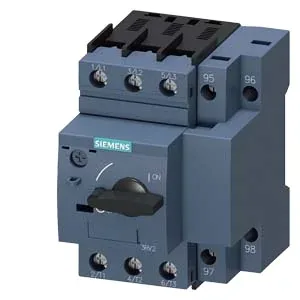
SIRIUS motor protection breaker with integrated overload relay
It combines short-circuit and overload protection in a single device, sized for direct-on-line motor starting applications. This matches the thermal withstand curve of most IEC and NEMA design B motors. Ground fault detection is not included; that function would need a separate RCD or GFCI module upstream.
For higher fault currents, the breaker requires upstream backup fuses: at 400 V, gL/gG 63 A fuses; at 500 V and 690 V, gL/gG 50 A fuses. This is standard for motor protection breakers — the fuses handle the high-energy arc while the breaker provides the thermal overload curve. Motor horsepower ratings are specified per voltage: 3 hp at 230 V, 1.5 hp at 110/120 V, and 7.5 hp at 200/208 V. These are the maximum motor sizes the breaker can protect at those line voltages — oversizing the breaker to a larger motor would lose overload protection.
Width is 65 mm. Mounting position is any. The zero forward/backward clearance means it can be stacked flush against a back panel or enclosure door — useful in shallow enclosures. Dimensions are 97 mm deep, 65 mm wide, 97 mm high. The depth is the critical dimension for shallow enclosures — verify your gland plate or door clearance allows the full 97 mm plus wiring space. Main circuit terminals are screw-type, accepting 2x (0.5 to 1.5 mm²) or 2x (0.75 to 2.5 mm²) solid or stranded conductors. Terminal screw size is M4. Strip length and torque values should follow the manufacturer's installation instructions.
Environmental and operational limits
Maximum switching frequency is 15 operations per hour at AC-3 and AC-3e duty. This is typical for a motor protection breaker — it is not designed for frequent switching like a contactor. For applications requiring more than 15 starts per hour, use a contactor for the switching and this breaker only for backup protection.