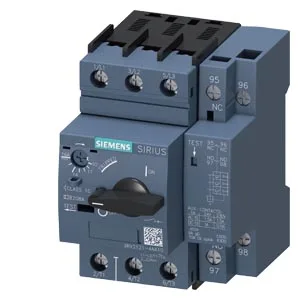
For motor sizing, this corresponds to 2 hp at 230 V, 1 hp at 110/120 V, and 3 hp at 200/208 V, per the datasheet. Breaking capacity is 100 kA at 240 V, 25 kA at 400 V, 5 kA at 500 V, and 2 kA at 690 V. This is the SCCR (short-circuit current rating) the panel designer needs for the branch circuit. The rated voltage range spans 20 to 690 V, covering standard low-voltage networks. Maximum switching frequency under AC-3 duty (motor starting) is 15 operations per hour — adequate for a motor that starts a few times per shift, not for a high-cycling application like a rapid-reversing conveyor.
Dimensions are 65 mm width, 97 mm depth, 97 mm height. Required clearances: 50 mm upwards and downwards, 30 mm at the sides, 0 mm forwards and backwards — so it can be stacked tightly front-to-back but needs breathing space above and below for arc quenching and thermal dissipation. Main circuit terminals are screw-type, accepting 2× (0.5 to 1.5 mm²) or 2× (0.75 to 2.5 mm²) solid or stranded conductors. The main contact screws are M4 size. The storage range is wider — that limit governs handling, not running.
For fuse backup coordination: the maximum fuse ratings at various voltages are gL/gG 63 A at 400 V, gL/gG 50 A at 500 V, and gL/gG 40 A at 690 V. These are the upstream fuse sizes that allow the breaker to clear a fault within its rated breaking capacity.