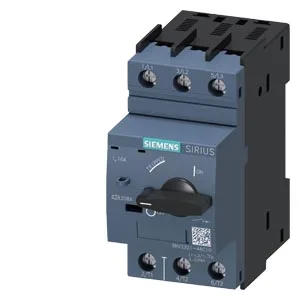
SIRIUS 3RV2321-4AC10 – circuit breaker for starter combinations
This isn't a general-purpose branch breaker; it's sized and coordinated for the motor branch circuit, with a rated operating voltage range of 20 to 690 V. Breaking capacity is the headline here: 100 kA at 240 V AC, 25 kA at 400 V, and 2 kA at 690 V. That 100 kA figure at 240 V means it can safely interrupt high-fault-current scenarios common in North American 240 V delta or 120/240 V split-phase panels, without upstream fuses needing to clear first. At 400 V, the 25 kA rating still covers most industrial distribution boards. Fuse backup coordination is specified: at 400 V, a gL/gG 63 A upstream fuse; at 500 V, 50 A; at 690 V, 40 A. If you're working to IEC 60947-2 or UL 508A, these fuse ratings tell you what the upstream protection needs to be to maintain the SCCR.
That zero forward clearance means you can butt it against a gland plate or enclosure wall without derating, which simplifies panel layout. Terminals are screw-type on the main current circuit, accepting 2×(1…2.5 mm²) or 2×(2.5…10 mm²) solid or stranded. Main contact screws are M4.
No ground-fault or phase-failure detection built in — that's by design for the starter-combination role, where the upstream motor starter or overload relay handles those functions.