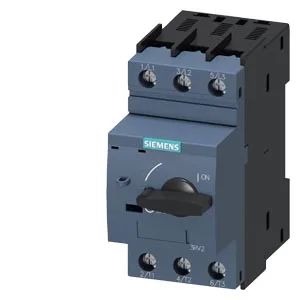
Rated voltage spans 20 to 690 V, covering most low-voltage motor circuits globally. At 400 V the breaking capacity is 25 kA, at 500 V it drops to 5 kA, and at 690 V to 2 kA — so the SCCR headroom shrinks as line voltage rises; verify your point-of-fault current at the actual system voltage. The motor horsepower ratings are given for several common voltages: 3 hp at 230 V, 7.5 hp at 220/230 V, 15 hp at 460/480 V. This tells you the maximum motor frame it can protect at those voltages — not the continuous current rating alone, but the motor full-load current the breaker is calibrated to coordinate with. The switching frequency is limited to 15 operations per hour at AC-3 and AC-3e duty — that is about one start every four minutes, so it is sized for infrequent starting (pumps, fans, compressors) rather than jogging or high-cycle applications. Fuse backup ratings are specified: at 400 V use a gL/gG 63 A fuse upstream, at 500 V and 690 V use gL/gG 50 A. These are the maximum fuse sizes that preserve the breaker's interrupting rating — if you fuse higher, the breaker may not clear a fault safely. The conductor cross-section accepted is 2x 1 to 2.5 mm² or 2x 2.5 to 10 mm² solid or stranded, with M4 screws on the main contacts.
Physical fit and clearance needs
Dimensions are 45 mm width, 97 mm height, 97 mm depth. The 45 mm width is three standard 15 mm module spaces on DIN rail — important for panel fill calculations. Clearance requirements: 50 mm upwards, 50 mm downwards, 30 mm at the side, 0 mm forwards and backwards. The zero forward/backward clearance means it can be mounted flush against a panel door or backplate without derating, but the 50 mm vertical gap above and below must be kept free for arc venting and heat dissipation.