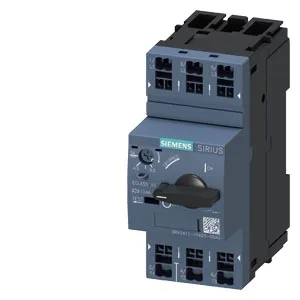
The Siemens SIRIUS 3RV2411-1FA20-0DA0 is a circuit breaker specifically designed for transformer protection, size S00. It's a current-production item, so no lifecycle concerns for a new BOM line. Rated at 1.1 kW at 230 V, it provides a Class 10 trip characteristic, meaning it will hold through motor inrush but trip quickly on a sustained overload — standard for protecting the transformer primary winding against secondary-side faults.
Any mounting position is allowed. No need for ferrules, though they help on stranded — strip length is standard for the cage. That's tight enough for most DIN-rail layouts, but watch the upward gap if you're stacking breakers.
The Class 10 trip curve is the key selection parameter here — it allows up to 10 seconds at 7.2x rated current before tripping, which covers transformer magnetizing inrush without nuisance trips. If your transformer has a higher inrush or you need coordination with downstream breakers, check the time-current curve. The back-up fuse recommendation is gG 32 A at 400 V or 500 V, stepping down to gG 25 A at 690 V — size the upstream fuse accordingly. No derating needed in most ventilated enclosures, but if it's in a sealed box next to a transformer, watch the ambient. No ground fault or phase failure detection built in — this is a straight thermal-magnetic breaker. If you need those functions, you'd add a separate relay or move to a motor-protective circuit breaker variant.