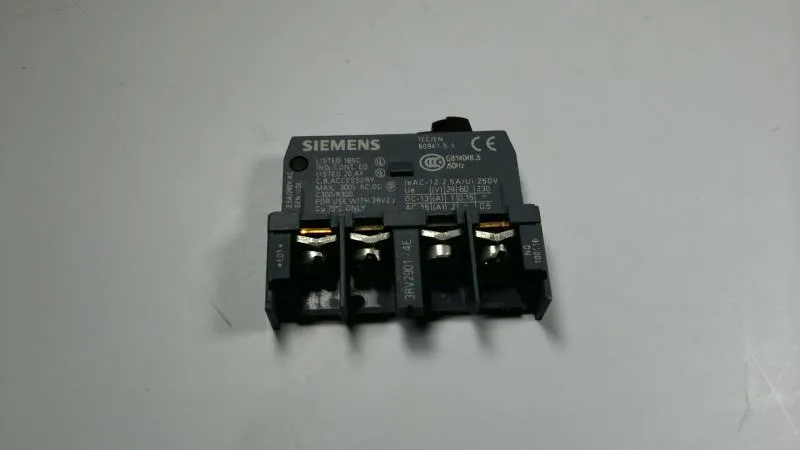
The maximum switching current is 2.5 A, but the real-world capability depends on the voltage. At 24 V it handles 1 A, at 48 V it drops to 0.3 A, at 60 V it handles 0.15 A, and at 230 V it handles 0.5 A. These are the contact ratings for the auxiliary circuit — they govern what PLC output or relay coil this switch can safely interrupt. The 2.5 A maximum is the thermal current; the voltage-specific values reflect the arc-quenching limits at each level. For a 24 VDC control circuit, the 1 A rating covers most contactor coils and indicator loads; at 230 VAC, the 0.5 A rating suits signal-level switching but not a power circuit.
The switch uses plug-in fixing to attach to the front of the breaker — no tools needed for installation, but removal requires depressing the latch. The ring terminal lug connection accepts ring-tongue terminals on the control wiring; this is less common than screw-clamp or spring-cage on auxiliary blocks, so verify your panel's termination preference. The 45 mm width matches the standard S0/S2/S3 breaker width, and the 17 mm depth keeps the assembly within the breaker envelope — no additional DIN-rail space consumed.