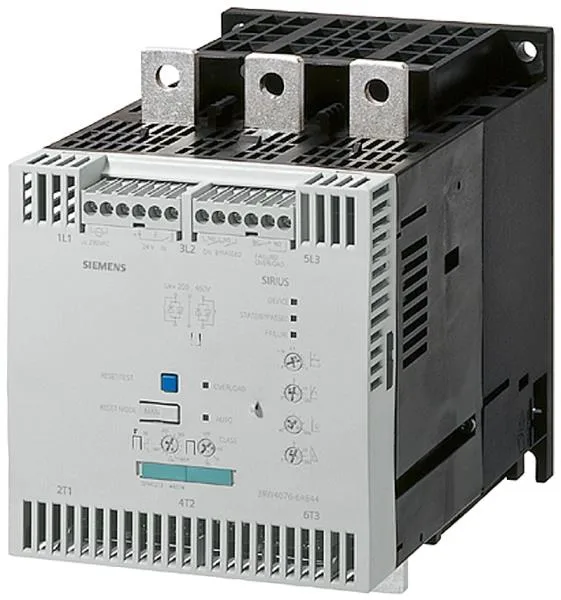
Rated current and what it means for the motor
The 3RW4075-2BB34: That 40 °C figure is the baseline — above that, the thyristor junction temperature climbs and the output must be backed off. For a 315 A motor in a 50 °C panel, this starter lands right at the limit; for a 280 A motor at 60 °C, it's maxed out. The derating temperature is 40 °C, so if your enclosure runs hot, size up.
Mounting and connections — what fits in the panel
This is a size S12 frame — 230 mm high, 160 mm wide, 278 mm deep — fastened by screw fixing. The main current circuit uses busbar connection, accepting 2/0 to 500 kcmil at the back clamping point and 3/0 to 600 kcmil at the front. Stranded cable from 70 to 240 mm² or finely stranded 50 to 240 mm² fits the power terminals. Solid control wiring is 2x (0.25 to 1.5 mm²). Mounting position allows vertical surface with ±10° rotation without an additional fan; with the optional fan, ±90° rotation and ±22.5° tilt front/back.
Protection and control features
Built-in motor overload protection and intrinsic device protection are standard. Adjustable current limitation lets you set the starting current below the motor's locked-rotor draw — useful for soft starting conveyors or pumps where mechanical shock is a concern. Minimum load is 20 % of the rated current, so it won't regulate properly on a lightly loaded motor. External reset is available for remote restart after a fault. Pollution degree 3 per IEC 60947-4-2 means it's rated for industrial environments with conductive dust or humidity.
Coil voltage and operating conditions
Insulation voltage rated 600 V. Maximum motor cable length is 300 m — beyond that, capacitive charging current can cause nuisance trips or reduce starting torque. Not configurable for inside-delta connection.