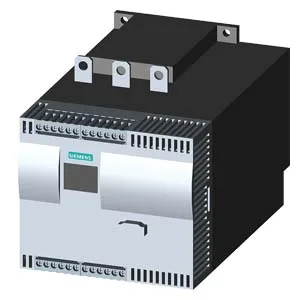
Rated current and thermal derating — what the 196 A figure actually governs
The 3RW4434-2BC44: The 196 A rating at 40 °C ambient is the ceiling for continuous motor current in a standard panel environment — provided the enclosure ventilation keeps the internal air below that threshold. At 50 °C the same unit delivers 173 A, and at 60 °C it drops to 152 A. The derating temperature is 40 °C, meaning any installation above that must apply the published curve; a 60 °C ambient cuts the available current by over 20 %, which matters when sizing for a pump or fan that runs near full load in a hot switchroom. The insulation voltage is rated 690 V, and the operating frequency covers 50 to 60 Hz at 230 V nominal.
Mounting, connection, and panel integration
That tilt range is useful when the backpanel is not perfectly plumb or when the starter sits on a swing frame. Dimensions are 170 mm wide, 200 mm high, 270 mm deep — the depth is the dimension that drives cabinet depth; the 270 mm figure means a 300 mm deep enclosure is tight, and 400 mm is comfortable for the busbar or cable bend radius behind it. Main current circuit connection is via busbar, accepting 4 to 250 kcmil. The busbar connection is the preferred method for the main circuit — if you are landing cable, the lug range covers up to 250 kcmil, which is roughly 120 mm², matching the upper end of the stranded range.
Inside-delta wiring and adjustable current limit — what they mean for the motor circuit
The inside-delta circuit capability means the thyristors can be wired in the delta legs of a six-lead motor, reducing the current through each SCR pair to 58 % of the line current. This is the standard configuration for larger soft starters — it halves the device rating needed for a given motor FLA, provided the motor has six leads accessible. The adjustable current limitation lets the user set the starting current between 8 % and roughly 400 % of the motor FLA, depending on the parameterisation; the 8 % minimum load figure is the floor below which the starter may not reliably detect the motor load. Motor overload protection and intrinsic device protection are both onboard — the starter monitors its own thyristor temperature and the motor current, so a separate overload relay is not required for most installations. The fault signal is shown on a display, and an external reset input allows remote clearing of trip conditions, which is standard for unattended pump or conveyor stations.
The lifecycle stage is marked as current, meaning Siemens still lists this order code in the active catalog. Pollution degree 3 per IEC 60947-4-2 means the device is rated for industrial environments where conductive pollution occurs or dry non-conductive pollution becomes conductive due to condensation — standard for most control panels not in a climate-controlled clean room. The maximum wire length from starter to motor is 500 m, which is typical for soft starters and limits the cable charging current on long runs.