ATEX and IECEx — the hazardous-location angle
The 3RW5055-2TB04: Both ATEX and IECEx are listed on this soft starter — that means it carries the certifications for installation in potentially explosive atmospheres (gas and dust). For a maintenance-spares purchaser or a site electrical engineer, this is the single most important compliance check: if your panel is in a Zone 1/2 or Zone 21/22 area, this part keeps the nameplate compliant without an external isolation barrier. The ATEX and IECEx marks are backed by CE and UL/CSA approvals — so the same unit ships into European ATEX directives, North American hazardous-location installations, and IECEx-adopting markets without a second variant.
Trip Class 10A / 10E / 20E — what the selector means
The trip class determines how long the soft starter can carry the starting current before the overload protection trips. Class 10A (preset) and 10E allow starting times up to 10 seconds at 7.2× Ie; Class 20E extends that to 20 seconds. For a pump or a fan with a long acceleration ramp, you dial in 20E. For a conveyor or compressor that starts under light load, 10A keeps the protection tighter.
Fieldbus options — PROFIBUS, Modbus, EtherNet/IP, PROFINET
This soft starter carries PROFIBUS, Modbus RTU, Modbus TCP, EtherNet/IP, and PROFINET on the communication module — you can drop it into a Siemens S7 environment (PROFINET/PROFIBUS) or a Rockwell/Allen-Bradley line (EtherNet/IP) without a gateway. Modbus TCP covers the rest of the PLC landscape. PROFIenergy is supported in conjunction with the PROFINET standard communication module — useful for data-center or production-line energy management where the soft starter needs to report power consumption or enter standby on command.
Mounting and panel fit — dimensions and clearances
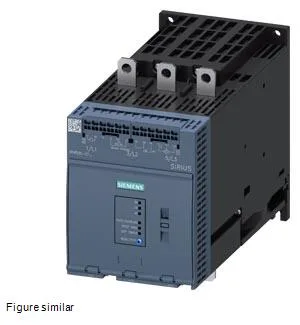
The 3RW5055-2TB04 measures 249 mm deep, 120 mm wide, and 198 mm high — a compact footprint for a 68 A soft starter. It mounts via screw fixing (not DIN-rail snap-on), so budget for four mounting holes on the backplate. Clearance requirements: 100 mm upwards, 10 mm forwards, 0 mm backwards, 75 mm downwards, and 5 mm at the sides. The 0 mm backwards clearance means it can sit flush against the backpanel — useful when you're packing multiple starters into a single enclosure. Mounting position is flexible: vertical surface with ±90° rotation and ±22.5° tilt front-to-back. That covers most panel layouts without needing a special bracket.
Operating temperature and derating
Rated for -25°C to +60°C during operation — but the spec explicitly notes derating at temperatures of 40°C or above. If your panel ambient runs at 50°C, expect the continuous current rating to drop; the exact derating curve is in the manual. For a data-center or foundry installation, factor this into the thermal budget. Shock resistance is 15 g / 11 ms, dropping to 12 g / 11 ms with potential contact lifting — relevant for mobile or high-vibration installations like mining conveyors or shipboard pumps.
Soft-start features — voltage ramp, pump ramp down, soft torque
Voltage ramp and soft torque are both present — voltage ramp gives a linear acceleration profile, while soft torque reduces the initial current spike for loads that are sensitive to sudden torque (like a conveyor with a loose belt or a pump with a closed discharge valve). Pump ramp down is also listed — this extends the deceleration time to prevent water hammer in pumping systems. If you're replacing a failed starter on a wastewater lift station, this feature alone justifies the swap. Auto-reset and remote reset (by cycling the control supply voltage) are supported — useful for unattended sites where you want the starter to retry after a fault without a site visit.