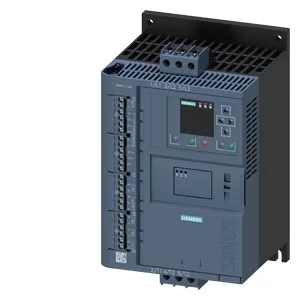
Hazardous-area motor starting — ATEX and IECEx certified
The 3RW5516-1HA04 carries both ATEX and IECEx certification, meaning it can be installed in Zone 1 or Zone 2 explosive-gas environments without an external isolation barrier — the soft starter itself is the certified interface between the hazardous-area motor and the safe-area control system. This certification covers the full rated voltage range of 200-480 V, so the same unit works on 230 V, 400 V, and 480 V motor systems common in chemical, oil/gas, and pharmaceutical plants.
Trip class selection for motor protection
Trip class is configurable from CLASS 10A (fastest protection for submersible pumps and compressors) through CLASS 10E, 20E, and 30E (slower trip for high-inertia loads like centrifuges and crushers) per IEC 60947-4-2 — the default 10A setting protects standard motors, but you can dial it up for loads that need a longer acceleration ramp without nuisance tripping. The 1.15 service factor means the starter can sustain 115 % of the motor's rated current continuously — useful when the motor is oversized for the load or when ambient temperature derating applies. DC braking and combined braking give controlled deceleration without relying on mechanical brake wear — the starter injects DC into the motor windings to stop rotation, which is especially useful on conveyors and hoists where coast-to-stop is unacceptable.
Fieldbus integration and analog feedback
The starter speaks Modbus RTU, Modbus TCP, EtherNet/IP, and PROFIBUS natively — no external gateway needed for most PLC ecosystems (Siemens S7, Allen-Bradley CompactLogix, Schneider M340). The analog output can be configured as 4-20 mA or 0-10 V to send motor current, power, or torque to a PLC analog input or local panel meter — useful for trending motor load over time or feeding into a DCS. PROFIenergy support (with the appropriate PROFINET communication module) allows the starter to coordinate energy-saving pauses during production breaks — the motor is ramped down and back up without a full stop/start cycle.
Pump ramp down and torque control for process loads
Pump ramp down gradually reduces motor speed during stop, eliminating the water hammer that damages piping and valves in centrifugal pump installations — the deceleration rate is parameterizable to match the system's hydraulic time constant. Torque control mode lets the starter regulate motor torque during start and stop, not just voltage — this is critical for conveyors that must accelerate without jerking the belt or for mixers that need a controlled torque profile to avoid splashing. The breakaway pulse delivers a short high-torque burst at the start to break loose a stuck or high-friction load (like a cold pump or a conveyor with frozen bearings) before the soft-start ramp takes over.
Panel mounting and clearance requirements
Dimensions are 275 mm height, 170 mm width, and 152 mm depth — the unit mounts on a standard DIN rail or directly to a backplate. Minimum clearance around the unit: 100 mm above, 75 mm below, 10 mm in front, 5 mm at the sides, and 0 mm behind — essential for airflow and cable bending radius. Screw terminals accept two conductors per pole: 1.0-2.5 mm² and 2.5-10 mm² — enough for the control wiring and the motor power cables without needing terminal blocks for the smaller signals.
Compliance and approvals — UL, CSA, CE
UL and CSA approvals cover North American installations — the starter is listed for use in UL 508A industrial control panels without additional derating or external protection coordination. CE marking confirms compliance with the Low Voltage Directive and EMC Directive for European markets — the starter carries the CE logo on the nameplate, and the Declaration of Conformity is available from Siemens. Accuracy class 5 per IEC 61557-12 means the built-in current measurement is within ±5 % of reading — sufficient for motor protection and energy monitoring without an external current transformer.
Active production — sourcing posture
Firmware updates can be applied in the field via the parameterization interface — the starter supports firmware update, so you can keep it current with the latest Siemens motor-control algorithms without replacing the hardware.