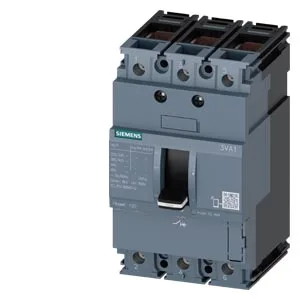
The Siemens SENTRON 3VA1020-2ED36-0BA0 is a 3-pole molded case circuit breaker (MCCB) rated 20 A at 40 °C with a TM210 thermal-magnetic trip unit — the thermal element handles overloads, the magnetic element clears short-circuits. Its interrupting capacity hits 52.5 kA at 240 V AC, 32 kA at 415 V, and 13.6 kA at 440 V, so it handles high-fault utility feeds or transformer secondaries in commercial and light industrial distribution panels. No ground-fault monitoring module is fitted, so if you need GF protection that's a separate accessory add-on. Dimensions are 130 mm height, 76.2 mm width, 70 mm depth — a standard SENTRON 3VA1 frame footprint that fits the same DIN-rail or screw-mount panel cutout as other 3VA1 breakers. The 14.5 W maximum power loss is moderate for a 20 A frame; factor that into enclosure thermal rise if you're packing multiple breakers in a sealed cabinet.
Current rating across the temperature range
The TM210 trip unit holds a full 20 A from 40 °C through 55 °C (–), then derates to 19 A at 60 °C and 65 °C, and stays at 19 A at 70 °C (–). That's a clean thermal curve — no derating until you cross 55 °C, which covers most panel ambient conditions. If your enclosure runs above 55 °C, plan for the 1 A reduction or move to a 25 A frame.
Breaking capacity — the real SCCR story
The interrupting ratings are given at multiple voltages: 52.5 kA at 240 V, 32 kA at 415 V, 13.6 kA at 440 V, and 7.5 kA at both 500 V and 690 V (–). That 52.5 kA at 240 V is a strong number for a 20 A frame — it means this breaker can be used on high-fault-capacity 240 V services without upstream current-limiting fuses. At 480 V (not explicitly listed, but interpolate between 440 V and 500 V), expect roughly 10–11 kA, which still covers most 480 V panel SCCR requirements.
Undervoltage release — what it does
The undervoltage release (UVR) built into this variant trips the breaker when the control voltage falls below a set dropout threshold — typically 70–35% of rated voltage per IEC 60947-1. This is mandatory in many motor feeder designs to prevent automatic restart after a voltage dip. The UVR is factory-fitted; no field kit required. Note that the trip indicator is not present, so there's no mechanical flag showing the breaker tripped on UV versus overcurrent — you'd need to check the auxiliary contact or the load status.
The storage minimum of -40 °C is typical for cold-weather sites; the operating maximum of 70 °C matches the derating curve above. No communication function or other measurement function is fitted — this is a straight thermal-magnetic breaker, not a metering or communicating device.