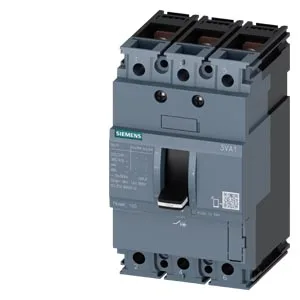
What it is and what it does in the panel
The Siemens 3VA1020-3ED32-0BH0 is a SENTRON molded case circuit breaker (MCCB) designed for line protection in distribution panels. It's a 3-pole unit rated at 20 A continuous at 40 °C, and it holds that rating up to 55 °C before it starts to derate — at 70 °C it's still good for 19 A. That thermal stability matters when the breaker sits in a crowded enclosure next to other heat sources. The interrupting capacity is the headline number here: 75.6 kA at 240 V AC, 52.5 kA at 415 V, 32 kA at 440 V, and it still holds 7.5 kA all the way up to 690 V. That's a lot of fault-clearing muscle for a 20 A frame — it tells you this breaker is built for high-available-fault-current installations where a standard MCB would weld itself shut. It ships with an undervoltage release (UVR) built in, plus two auxiliary switches and one trip alarm switch (HQ). The UVR means the breaker trips if control voltage drops — common in safety circuits or remote-shutdown schemes. The auxiliary switches let you feed status back to a PLC or indication lamp without adding external relays.
Physical fit and panel integration
Dimensions: 130 mm high, 76.2 mm wide, 70 mm deep. That's a standard 3-pole MCCB footprint — it mounts on a DIN rail or directly to a backplate via the screw terminals. The 76.2 mm width (3 inches) is the same as many other 3-pole SENTRON breakers in the 3VA family, so swapping between ratings in the same panel slot is straightforward. Rated insulation voltage is 800 V. Maximum power loss is 14.5 W.
What the ratings mean for your coordination study
The 75.6 kA at 240 V is the interrupting capacity — the maximum fault current this breaker can safely clear without exploding or welding contacts. In a panel fed from a transformer with high available fault current, that number determines whether this breaker can be the main or a downstream device. At 415 V it still clears 52.5 kA, which covers most industrial distribution scenarios. The 20 A continuous rating at 40 °C is the thermal current — what it can carry indefinitely without tripping. The thermal-magnetic trip curve (not specified here, but standard for the 3VA line) handles overloads and short circuits. The trip indicator on the front tells you whether it tripped on overload or fault, which saves troubleshooting time on a down line.
