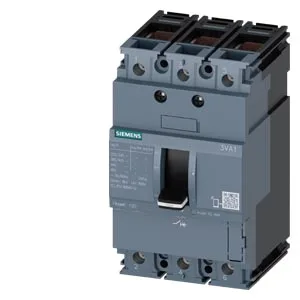
It's built to sit in a distribution panel and clear faults fast. Breaking capacity is the headline here: 75.6 kA at 240 V, 52.5 kA at 415 V, 32 kA at 440 V, and still 7.5 kA at 690 V. That 75.6 kA figure at 240 V means it handles high available fault current on the secondary side of a 240/120 V distribution transformer without needing a current-limiting fuse upstream. The 690 V rating is useful for 600 V class Canadian or 690 V European industrial networks — it's not just a 480 V breaker.
Derating and thermal reality
At 55 °C it drops to 19.2 A, at 60 °C to 18.8 A, and at 70 °C to 18 A.
That gives you two form-C contacts for status feedback and a dedicated alarm contact that changes state only on a trip event — useful for remote fault indication without tying up the aux contacts.
Integration notes
The 3VA1020-3ED36-0AH0 uses a TM210 release — fixed thermal and fixed magnetic settings. No dials to adjust, no interchangeable trip units. That simplifies ordering and panel wiring but means you must size the breaker to the load current exactly; there's no headroom to turn it up later. The 15000 latching endurance cycles is typical for a molded case breaker in distribution duty — not a frequent-switching device like a contactor. If your application needs remote tripping or status monitoring beyond the aux contacts, you'll need to add external components. The breaker itself is a clean, passive overcurrent protector.