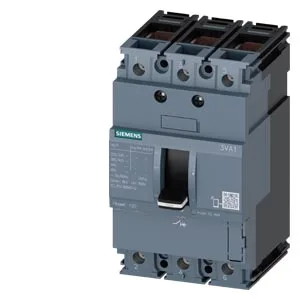
Line protection MCCB with undervoltage release
The Siemens SENTRON 3VA1020-3ED36-0CA0 is a 3-pole molded case circuit breaker rated for 20 A continuous current at 40 °C, with a TM210 thermal-magnetic overcurrent release. It carries a 75.6 kA interrupting rating at 240 V, stepping down to 52.5 kA at 415 V and 32 kA at 440 V — numbers that matter when you're coordinating selectivity downstream of a transformer or generator.
Current-carrying capacity across the panel temperature range
At 55 °C it derates to 19.2 A, dropping to 18 A at 70 °C. That thermal curve means you don't lose headroom in a warm enclosure unless ambient pushes past 50 °C — common in packed panels or near motor starters.
The breaker measures 76.2 mm wide, 130 mm tall, and 70 mm deep — a standard 3-pole MCCB footprint that fits SENTRON distribution blocks and panel-mounting plates. No auxiliary contacts are fitted as standard; the auxiliary trip accessory (order code 3VA9608-0BB24) is available as a field-addable option if you need remote status.
What the TM210 release and UVR mean for your circuit
The TM210 is a fixed thermal-magnetic release — thermal element for overload, magnetic for short-circuit. No electronic adjustment, no communication, no phase-failure detection. That keeps it simple and reliable for line protection where you don't need metering or remote trip. The undervoltage release is wired separately; if its coil loses power the breaker trips immediately. That's the standard way to implement a safety shunt or generator transfer interlock.