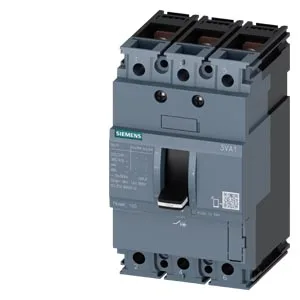
What this MCCB is and what it does
The 3VA1025-4ED32-0CH0: Rated continuous current Iu is 25 A, and the thermal-magnetic release is a TM210 — the fixed thermal element and magnetic trip coil are set at the factory; no field adjustment on the thermal pickup. The insulation voltage Ui is 800 V, giving headroom for 480/600 VAC systems. Breaking capacity is the headline: 121 kA at 240 V, 75.6 kA at 415 V, 52.5 kA at 440 V, and 11.9 kA at 690 V. That's enough for high-fault utility feeds or transformer secondaries — the 121 kA figure at 240 V is what you'd use for a 120/240 V split-phase service entrance.
Thermal derating and panel fit
The breaker carries a full 25 A from 40 °C up to 50 °C ambient. At 55 °C it drops to 24 A, at 60 °C to 23.5 A, at 65 °C to 23 A, and at 70 °C to 22.5 A. If your panel runs hot — say 55 °C inside a sealed NEMA 12 enclosure — you need to account for that 1 A loss. The operating range is -25 °C to +70 °C, storage from -40 °C to +80 °C. Physical size: 76.2 mm wide (roughly 3 inches — three 1-inch pole spaces), 130 mm tall, 70 mm deep. That's a standard MCCB footprint for a 25 A frame; it'll drop into most SENTRON panelboards and DIN-rail adapters. Front IP40 — fine for a clean indoor panel, but not for washdown.
Auxiliary contacts and undervoltage release
This variant comes with 2 auxiliary switches plus 1 trip alarm switch (HQ configuration) — handy for remote status indication or interlocking. The undervoltage release (UVR) is built in; if the control voltage drops below the dropout threshold, the breaker opens. No communication module, no ground-fault monitoring, no phase-failure detection — this is a straightforward, no-frills protection device.
