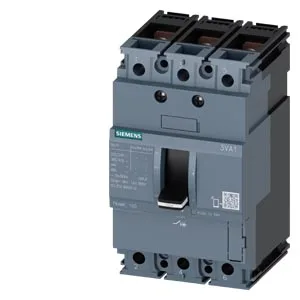
It's a 3-pole unit rated at 40 A continuous current (Iu) through 50 °C, with the TM210 thermal-magnetic release handling the overcurrent and short-circuit tripping. That UVR drops the breaker if supply voltage falls below a threshold, which is useful for motor starters or safety circuits where you want the load to drop out on a brownout.
At 55 °C it drops to 38.4 A, at 60 °C to 37.6 A, at 65 °C to 36.8 A, and at 70 °C to 36 A. That's a gentle slope — only 10% loss at the top end — so if you're stuffing this breaker into a tight panel with other heat sources, you've got headroom. Mechanical endurance is listed at 15,000 operations — that's the latching endurance, meaning the number of open-close cycles the mechanism is rated for before wear. For a line-protection MCCB that sees infrequent switching (maybe a few dozen operations a year), that's effectively a lifetime supply. The front protection is IP40, so it keeps tools and fingers out but isn't sealed against dust ingress — mount it inside a panel enclosure.
Breaking Capacity Across Voltages — Coordination Reality
This breaker's interrupting rating drops as voltage climbs: 121 kA at 240 V, 75.6 kA at 415 V, 52.5 kA at 440 V, and 11.9 kA at 690 V. Those numbers matter for selectivity studies — if your fault current at the panelboard is 65 kA at 415 V, this MCCB handles it cleanly. At 690 V you're limited to 11.9 kA, so on a 690 V system you'd need to verify the available fault current doesn't exceed that, or move to a higher-rated frame.
Physical Fit — Panel Integration Notes
The width at 76.2 mm is a 3-pole frame, so if you're replacing a 3-pole MCCB from another manufacturer, check your existing cutout width; many 3-pole MCCBs land in the 75–80 mm range.