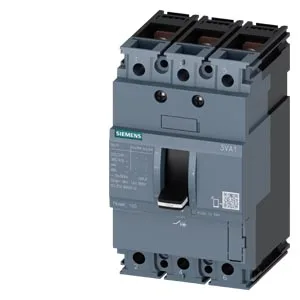
What this MCCB brings to the panel
The Siemens 3VA1040-4ED32-0CH0 is a 3-pole SENTRON molded case circuit breaker rated 40 A continuous at 40 °C, with a 121 kA interrupting capacity at 240 V — that's the SCCR headroom that keeps a fault from cascading upstream in a high-fault panel. It's designed for line protection, meaning it sits on the feeder or branch protecting cables and buswork, not a specific motor load. The 70 mm depth and 76.2 mm width match the standard SENTRON 3VA footprint, so it swaps into an existing panel layout without re-drilling the mounting plate.
Interrupting ratings by voltage — where it clears
This breaker's interrupting capacity drops as line voltage rises: 121 kA at 240 V, 75.6 kA at 415 V, 52.5 kA at 440 V, and 11.9 kA at both 500 V and 690 V. The 11.9 kA at 690 V is the number to check if you're feeding a 690 V drive or transformer — that's the weakest link in the selectivity chain. For most 480 V panels the 52.5 kA at 440 V is the relevant figure (close enough to 480 V for coordination studies).
Thermal derating and ambient limits
The 40 A rating holds flat from 40 °C up to 50 °C, then derates to 38.4 A at 55 °C, 37.6 A at 60 °C, 36.8 A at 65 °C, and 36 A at 70 °C. If the panel ambient runs above 50 °C — say inside a non-ventilated enclosure near a drive — you lose about 4 A by the top end. The operating range spans -25 °C to 70 °C, storage from -40 °C to 80 °C. Maximum power loss is 13.3 W, which matters for enclosure heat load calculations.
Auxiliary and release configuration
This variant ships with an undervoltage release (UVR) and a 2-auxiliary-switch + 1 trip-alarm-switch HQ configuration. The UVR means the breaker trips when control voltage drops below a threshold — useful for emergency-stop chains or power-loss protection on a machine. The trip alarm switch gives a separate dry contact that closes only on a fault trip, not on manual switching, which simplifies remote fault annunciation. Insulation voltage is rated 800 V.
