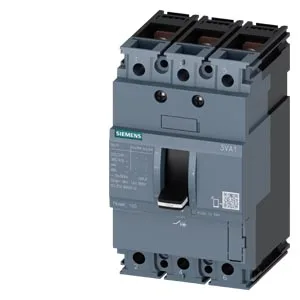
What this MCCB carries — and what it doesn't
The Siemens 3VA1050-3ED32-0CC0 is a SENTRON molded case circuit breaker (MCCB) designed for line protection — three poles, rated 50 A continuously at 40 °C, and derated to 45 A at 70 °C. That thermal curve means it holds steady up to 55 °C before the first amp drops off: 49 A at 55 °C, 48 A at 60 °C, 46 A at 65 °C, 45 A at 70 °C. No trip indicator, no voltage-trigger function, no communication module — this is a straight thermal-magnetic breaker with one specialty: an integrated undervoltage release (UVR) and two auxiliary switches HQ built in.
Breaking capacity — the voltage-dependent story
Interrupting rating drops sharply as system voltage climbs: 75.6 kA at 240 V, 52.5 kA at 415 V, 32 kA at 440 V, and 7.5 kA at both 500 V and 690 V. That 7.5 kA at 690 V is the hard ceiling — if your fault current exceeds that at 690 V, this breaker isn't the right pick. The 75.6 kA at 240 V gives plenty of headroom for North American 240/120 V split-phase or 240 V delta services. For 400 V-class European panels, the 52.5 kA at 415 V covers most distribution boards with typical transformer impedances.
Panel fit — dimensions and integration
Mounts on DIN rail or direct panel. Width 76.2 mm (3 in), height 130 mm (5.12 in), depth 70 mm (2.76 in). The 70 mm depth is the body only — allow clearance for cable bending radius and the undervoltage release wiring. The two auxiliary switches HQ are pre-installed; no separate aux kit to order. Undervoltage release (UVR) means the breaker trips if control voltage drops below the dropout threshold — common for emergency-stop chains or undervoltage protection on motor feeders.
