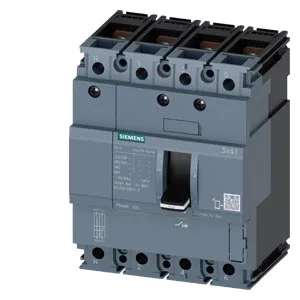
The 3VA1050-3ED42-0BH0 is a Siemens SENTRON 4-pole molded case circuit breaker (MCCB) rated for 50 A continuous current (Iu) at 40 °C, carrying that rating flat through 50 °C before a gentle thermal derating curve — 48 A at 55 °C, 47 A at 60 °C, 46 A at 65 °C, 45 A at 70 °C. That means for a panel running at a 50 °C ambient, the breaker still handles a full 50 A load without nuisance tripping; only above 50 °C does the thermal-magnetic TM210 release start backing off. The 75.6 kA interrupting rating at 240 V (52.5 kA at 415 V, 32 kA at 440 V, 7.5 kA at 690 V) tells you this breaker can safely clear a fault up to that level without rupturing or welding contacts — critical for high-fault-capacity distribution panels where upstream transformer size drives available fault current. The 800 V rated insulation voltage (Ui) and IP40 front protection suit it for installation in a standard IP54 or IP65 enclosure — the front face is protected against solid objects over 1 mm, but the terminals are not sealed, so it belongs behind a gland plate or enclosure door. The 15 000 mechanical endurance cycles (latching endurance) indicate the mechanism is rated for that many open-close operations under no-load conditions; for frequent switching under load, factor in the electrical endurance which is typically lower.
At 70 mm deep, 101.6 mm wide, and 130 mm tall, this MCCB fits a standard DIN-rail or panel-mount footprint common to the SENTRON 3VA platform. That alarm contact is useful for remote fault annunciation without wiring through the PLC input logic. This is standard for machinery safety circuits where loss of control power must remove line power. The TM210 thermal-magnetic release provides fixed thermal (overload) and magnetic (short-circuit) protection; there is no electronic adjustment or communication function on this variant, so it is a straight line-protection device, not a power-monitoring or selective-coordination breaker.