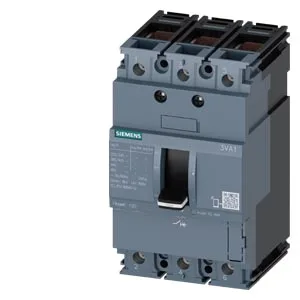
The Siemens SENTRON 3VA1080-4ED36-0KA0 is a 3-pole molded case circuit breaker rated 80 A continuous at 40 °C, with a TM210 thermal-magnetic overcurrent release and an integral shunt trip (STL) auxiliary release. Its interrupting capacity hits 121 kA at 240 V and 75.6 kA at 415 V — numbers that tell you it can handle high-fault utility feeds or transformer secondaries without cascading upstream.
Ratings that govern the real use
The 80 A rating holds flat from 40 °C to 50 °C, then derates to 78 A at 55 °C and 74 A at 70 °C. That means a panel running at 50 °C ambient gets the full 80 A; push it to 65 °C and you lose 5 A. The 800 V rated insulation voltage (Ui) covers 690 V line-to-line systems, and the interrupting curve drops to 11.9 kA at both 500 V and 690 V — so on a 690 V distribution bus, the available fault current needs to stay under that threshold.
At 70 mm deep, 76.2 mm wide, and 130 mm tall, this MCCB fits standard SENTRON 3VA panel cutouts and busbar systems. The shunt trip (STL) allows remote tripping from a safety circuit or emergency stop, which is common on motor control center feeders.
No successor has been published. The basic switch assembly (3VA10804ED360AA0) is a separate orderable component if you need a replacement mechanism without the full breaker.
What the TM210 release and shunt trip mean for commissioning
The TM210 designation indicates a thermal-magnetic release with a fixed thermal pickup at 80 A and magnetic trip set at 10x In (800 A). That's a standard motor-circuit profile — handles inrush without nuisance tripping, clears bolted faults fast. The shunt trip (STL) is a separate voltage-triggered release: apply rated control voltage and the breaker opens regardless of the handle position.