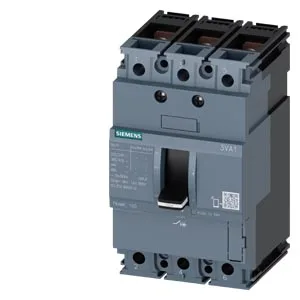
The TM210 thermal-magnetic overcurrent release handles both overload (thermal) and short-circuit (magnetic) protection — no electronic trip unit, so it's a straightforward replacement for existing thermal-magnetic MCCB installations.
This MCCB's interrupting capacity changes with system voltage, which is typical for molded case breakers. At 240 V it breaks 52.5 kA; at 415 V that drops to 32 kA; at 440 V it's 13.6 kA; and at 690 V it's 7.5 kA. The 52.5 kA at 240 V covers high-fault industrial and commercial panels where the available fault current is substantial. The 32 kA at 415 V is the figure most European 400 V distribution engineers will check first — it's adequate for most secondary distribution boards but may not cover a main service entrance with a large transformer. The 7.5 kA at 690 V is a niche figure for certain mining or marine 690 V systems.
Thermal derating — don't ignore the ambient temperature
The 16 A rating holds from 40 °C through 50 °C ambient. Above that, derating begins: 15.36 A at 55 °C, 15.04 A at 60 °C, 14.72 A at 65 °C, and 14.4 A at 70 °C. If this breaker sits in a warm enclosure near other heat sources, use the 55 °C or 60 °C column to size the load — a continuous 16 A load at 60 °C would nuisance-trip. The operating temperature range is -25 °C to 70 °C, with storage from -40 °C to 80 °C.
The breaker measures 130 mm high, 76.2 mm wide (3-pole), and 70 mm deep. The 76.2 mm width is a standard 3-pole MCCB footprint — it fits most DIN-rail or panel-mount enclosures designed for SENTRON or comparable 3-pole breakers.