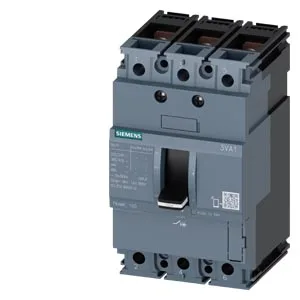
The Siemens SENTRON 3VA1096-4ED32-0BH0 is a 3-pole molded case circuit breaker (MCCB) rated for 16 A continuous current at up to 50 °C ambient, with a TM210 thermal-magnetic release configured for line protection. Its headline interrupting capacity is 121 kA at 240 V AC, dropping to 75.6 kA at 415 V and 52.5 kA at 440 V — numbers that tell you this breaker is sized for high-fault industrial panels, not light commercial distribution. The 16 A rating holds flat through 50 °C; above that it derates to 15.36 A at 55 °C and 14.4 A at 70 °C, so if your panel runs hot, size the load accordingly.
At 415 V (common European industrial supply) the 75.6 kA still covers most transformer-fed panels. The undervoltage release (UVR) is built in — if control voltage drops, the breaker trips, which is standard for emergency-stop or safety-related disconnects.
Panel integration
Dimensions are 130 mm height, 76.2 mm width, 70 mm depth — the width is a standard 3-pole MCCB footprint (roughly 3 x 25.4 mm per pole), so it fits existing cutouts for most 3-pole frames in this amp class. The 800 V rated insulation voltage (Ui) means it can be used on 690 V systems with adequate clearance — the interrupting capacity at 690 V is 11.9 kA, so verify the available fault current at that voltage.