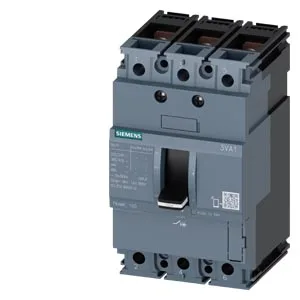
Its interrupting capacity hits 121 kA at 240 V and 75.6 kA at 415 V — numbers that tell you it's built for high-fault panels where a standard MCB would weld itself shut.
The 16 A rating holds from 45 °C through 55 °C. At 60 °C it derates to 15 A, and it stays at 15 A through 70 °C.
At 240 V the breaker clears 121 kA. At 415 V it's 75.6 kA, at 440 V it's 52.5 kA, and at 500 V and 690 V it holds at 11.9 kA. The steep drop above 440 V is typical for a 16 A frame — the arc energy scales with voltage, and the smaller contact gap can't sustain the same interruption. For 480 V or 600 V line-to-line systems, verify the available fault current is under 11.9 kA, or step up to a higher-frame 3VA variant.
Auxiliary contacts and signaling
The trip alarm closes only when the breaker trips on fault — useful for a remote shunt-trip signal or a PLC digital input that logs the event. The auxiliary switches track the main contact position, so they can drive a panel lamp or a status bit for the SCADA system.