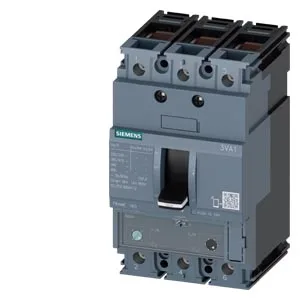
The Siemens 3VA1112-3EF36-0AD0 is a 3-pole SENTRON molded case circuit breaker (MCCB) rated for 125 A continuous current at 40 °C, with a TM240 thermal-magnetic overcurrent release. That 125 A holds flat from 40 °C up to 50 °C, then derates to 120 A at 55 °C, 117.5 A at 60 °C, 115 A at 65 °C, and 112.5 A at 70 °C — so if your panel ambient runs above 50 °C, the breaker's effective ampacity drops, and you need to account for that in the feeder sizing. The interrupting ratings are given at four voltage levels: 75.6 kA at 240 V, 52.5 kA at 415 V, 32 kA at 440 V, and 10.5 kA at 690 V. For a 480 V panel, the 440 V figure is the closest — 32 kA — which is the SCCR the breaker can clear at that voltage. It ships with three HQ auxiliary switches (form C, high-quantity contacts) factory-installed, so you get status feedback without adding a separate accessory block.
Endurance is listed at 15 000 operations, which is typical for a distribution-grade MCCB in line-protection duty.
The breaker measures 130 mm high, 76.2 mm wide, and 70 mm deep — a 3-pole footprint that fits standard Siemens SENTRON mounting plates and busbar systems.